
Carpenter Bee Control Services in Southeast Michigan
Professional Carpenter Bee Treatment That Protects Your Wood
Carpenter Bee Control Services in Southeast Michigan
Professional Carpenter Bee Treatment That Protects Your Wood
If you have noticed large bees hovering around your deck, eaves, or wood trim and found perfectly round holes bored into the surface, you are dealing with carpenter bees. Unlike most stinging insects, carpenter bees do not build hives or live in colonies — they nest by drilling into wood, and left unchecked, they will return to the same structures year after year, expanding existing galleries and creating new ones. What starts as a few small holes can become significant structural damage over several years, especially when woodpeckers move in to dig out the larvae and compound the destruction.
Defender Pest provides professional carpenter bee control for homeowners across Southeast Michigan. As a standalone service backed by a 30-day guarantee, our treatments are designed to eliminate active carpenter bees, protect the wood surfaces they are targeting, and stop the cycle of return and re-nesting that makes these insects so persistently frustrating to deal with on your own.
Understanding Carpenter Bees
Understanding Carpenter Bees
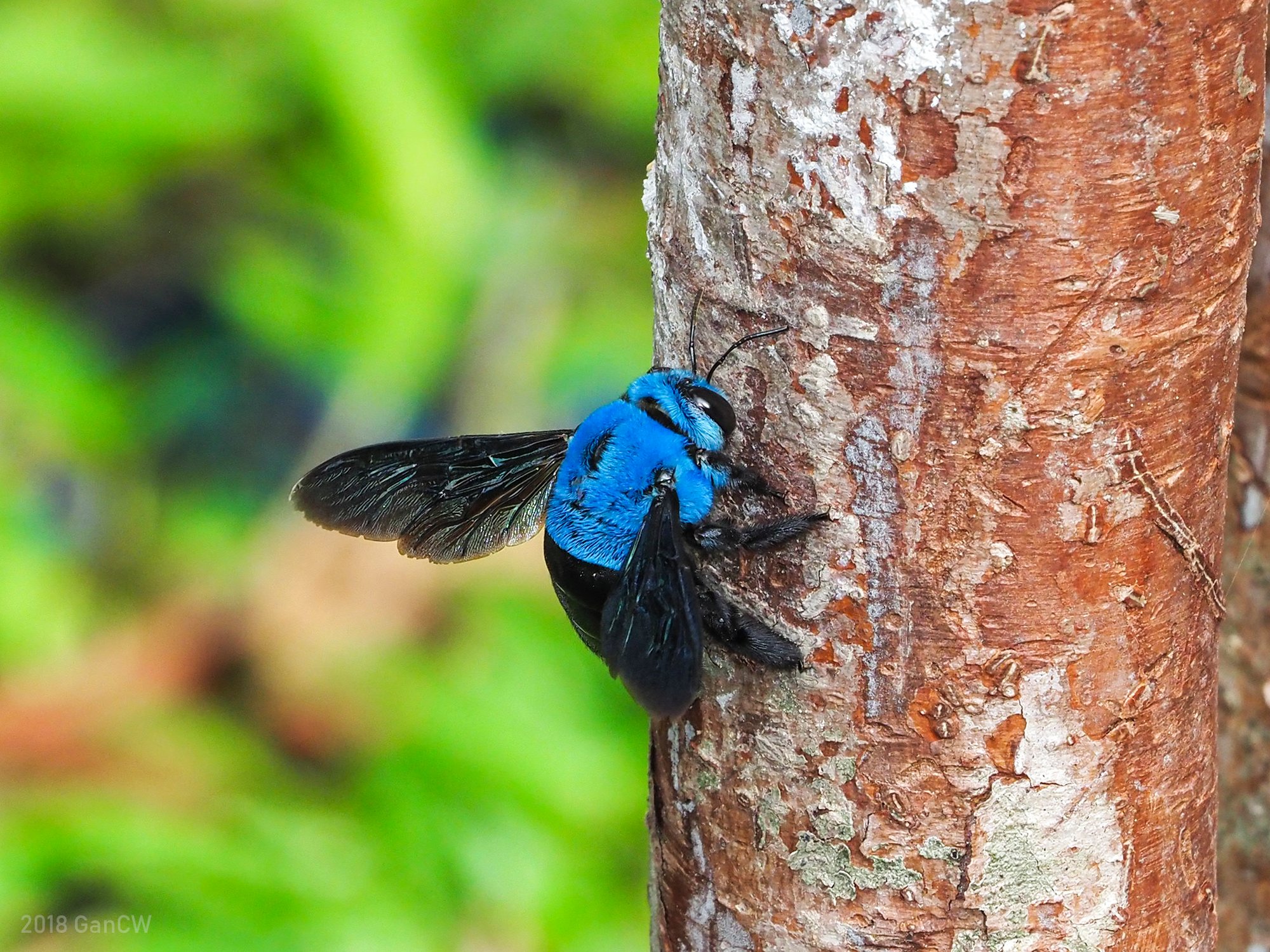
Carpenter bees are solitary bees, meaning each female builds and tends her own nest independently rather than living in a colony the way honeybees or bumble bees do. They are large bees, typically 12 to 25 millimeters long, and are commonly mistaken for bumble bees at a glance. The clearest way to tell them apart is the abdomen: bumble bees have fuzzy, pollen-covered abdomens, while carpenter bees have shiny, hairless abdomens that are distinctly black. Male carpenter bees have yellow faces and are the ones most homeowners notice — they hover aggressively around nesting sites and will fly close to people to investigate, but they have no stinger and cannot sting. Female carpenter bees have black faces, are capable of stinging, and are the ones doing the actual drilling.
Carpenter bees are also important pollinators. They are among the more effective pollinators for certain plant species, and some gardeners appreciate their presence in open areas away from structures. The problem is that their nesting behavior is incompatible with wood structures, and once established on a home, they are unlikely to move on without intervention.
How Carpenter Bees Damage Wood
Carpenter bees do not eat wood — they excavate it to create nests. A female carpenter bee drills an entry hole roughly a half inch wide, boring straight into a wood surface at a right angle for about an inch before turning and tunneling along the wood grain. These interior galleries, called brood cells, can extend six to twelve inches and in long-established nests may reach ten feet or more as females reuse and expand the same tunnels over several years.
Inside the nest, the female carpenter bee provisions each brood cell with a ball of pollen and nectar, lays an egg on it, and seals it off. Carpenter bee larvae hatch, feed on the pollen mass, and develop through pupal stage before emerging as adults — a process that takes about seven weeks from egg to adult. Carpenter bees typically emerge from their nests in April or May, mate in late spring, and new females begin drilling in early summer. The same nest sites are revisited the following spring, and the galleries grow longer with each season.
The direct damage from drilling holes compounds over time, but secondary damage often makes things worse. Carpenter bee larvae inside the galleries attract woodpeckers, who tear into the wood to reach them and cause woodpecker damage far more visible and structurally significant than the original bee holes. Water seeps into open holes and exposed galleries, accelerating wood rot and deterioration. Wooden structures that have hosted carpenter bees for multiple seasons without treatment can sustain damage that requires significant repair.
Signs of a Carpenter Bee Infestation
Signs of a Carpenter Bee Infestation
Carpenter bee activity is usually not difficult to identify once you know what to look for. These are the signs that indicate carpenter bees are nesting in or around your home.
- Round entry holes in wood. Carpenter bee holes are nearly perfect circles, roughly a half inch in diameter, drilled into the surface of exposed wood. They are cleaner and more uniform than the ragged holes left by other wood-boring insects. Fresh holes have no staining or discoloration around the opening.
- Sawdust or coarse frass below holes. When a female carpenter bee is actively drilling, she pushes wood shavings out of the entry hole as she works. Finding sawdust piles directly below a hole in wood is a reliable sign of recent or active drilling.
- Yellow staining around hole openings. Pollen and waste material from established nest galleries often stains the wood surface around and below the entry hole with a yellowish-brown discoloration. This staining indicates the nest has been in use for at least part of a season.
- Hovering male bees. Male carpenter bees are territorial and will hover conspicuously near nest sites, darting toward other insects, birds, and people who approach. Their aggressive hovering behavior is often what first draws a homeowner's attention to the problem, even though the males themselves are harmless.
- Woodpecker activity on wood siding or trim. Woodpecker damage to exterior wood surfaces — elongated holes or excavated strips along the grain — often indicates carpenter bee larvae are present inside. If you are seeing woodpecker damage on your home's exterior wood, a carpenter bee infestation is a likely cause worth investigating.
What Wood Carpenter Bees Target
Carpenter bees strongly prefer bare, weathered, unpainted, or unfinished wood. Soft woods like pine and cedar are particularly vulnerable, as are redwood, cypress, and fir. They favor wood surfaces with a natural grain that makes drilling easier, including deck boards, fascia boards, pergola beams, wood siding, window trim, porch railings, and any other exposed structural or decorative wood on the exterior of your home. Painted wood surfaces are significantly less attractive to carpenter bees, and painted surfaces in good condition are much less likely to be targeted. Any area of peeling, chipped, or bare wood on the exterior of your home is a candidate for carpenter bee nesting, particularly on south- and east-facing exposures that receive the most sun.
How Defender Pest Treats Carpenter Bees
Eliminating carpenter bees and protecting your wood from further damage requires a targeted approach timed to the bees' activity cycle. Defender Pest treats carpenter bee infestations as a standalone service, meaning every job gets the dedicated attention this pest requires rather than being folded into a general exterior spray.
Inspection and Assessment
Every carpenter bee service starts with an assessment of your property to locate all active nest holes, identify which wood surfaces are being targeted, and evaluate the extent of any existing damage. This gives our technicians a clear picture of where to focus treatment and what protective measures are most appropriate for your specific situation.
Insecticide Treatment
Insecticide dust applied directly into active nest galleries is the most effective method for killing carpenter bees in their nests. Dust formulations reach deep into the brood cells where liquid sprays cannot penetrate effectively, contacting adult bees, larvae, and developing eggs inside the gallery. Applications are timed to treat during periods when bees are present in the nest — typically in the evening when activity has slowed — to maximize contact with the population. Residual sprays are applied to the exterior wood surfaces being targeted to deter new activity and address bees that contact treated surfaces.
Hole Sealing and Wood Protection
After treatment, open holes should be sealed with wood putty or caulk to prevent new carpenter bees from using existing galleries as ready-made nesting sites the following spring. Timing matters here: sealing holes too early in the season traps developing larvae inside, which can lead to secondary pest issues as the larvae decay. Your technician will advise on the appropriate timing for sealing based on where you are in the season. Painting or staining any bare wood surfaces on the exterior of your home after treatment is one of the most effective long-term deterrents — carpenter bees strongly avoid painted surfaces in good condition.
For the best outcomes, heat and chemical treatments are often used together. Heat handles the immediate population across the treated space while residual chemical treatments and IGRs address any surviving bed bugs or newly hatched eggs in the days and weeks following the initial service.
How Defender Pest Treats Carpenter Bees
Eliminating carpenter bees and protecting your wood from further damage requires a targeted approach timed to the bees' activity cycle. Defender Pest treats carpenter bee infestations as a standalone service, meaning every job gets the dedicated attention this pest requires rather than being folded into a general exterior spray.
Inspection and Assessment
Every carpenter bee service starts with an assessment of your property to locate all active nest holes, identify which wood surfaces are being targeted, and evaluate the extent of any existing damage. This gives our technicians a clear picture of where to focus treatment and what protective measures are most appropriate for your specific situation.
Insecticide Treatment
Insecticide dust applied directly into active nest galleries is the most effective method for killing carpenter bees in their nests. Dust formulations reach deep into the brood cells where liquid sprays cannot penetrate effectively, contacting adult bees, larvae, and developing eggs inside the gallery. Applications are timed to treat during periods when bees are present in the nest — typically in the evening when activity has slowed — to maximize contact with the population. Residual sprays are applied to the exterior wood surfaces being targeted to deter new activity and address bees that contact treated surfaces.
Hole Sealing and Wood Protection
After treatment, open holes should be sealed with wood putty or caulk to prevent new carpenter bees from using existing galleries as ready-made nesting sites the following spring. Timing matters here: sealing holes too early in the season traps developing larvae inside, which can lead to secondary pest issues as the larvae decay. Your technician will advise on the appropriate timing for sealing based on where you are in the season. Painting or staining any bare wood surfaces on the exterior of your home after treatment is one of the most effective long-term deterrents — carpenter bees strongly avoid painted surfaces in good condition.
For the best outcomes, heat and chemical treatments are often used together. Heat handles the immediate population across the treated space while residual chemical treatments and IGRs address any surviving bed bugs or newly hatched eggs in the days and weeks following the initial service.
The Defender Pest Carpenter Bee Service Program
Carpenter bee control is a standalone service at Defender Pest, separate from our tri-annual 360 protection plan. Every service is backed by a 30-day guarantee: if carpenter bee activity continues after treatment, we return at no additional charge.
Pricing is based on the size of the property and the extent of the infestation. Defender Pest provides free inspections so you receive an accurate quote before any work begins rather than a flat estimate made without seeing the property. Contact us by phone or through our online quote form to get scheduled.
Ready to Protect Your Home?
No matter which corner of Michigan you call home, Defender Pest brings the same commitment to every yard we treat; professional service, certified technicians, and a protection plan built around your season. Ready to get started?
Give us a call or request your free quote online today.
Ready to Protect Your Home?
No matter which corner of Michigan you call home, Defender Pest brings the same commitment to every yard we treat; professional service, certified technicians, and a protection plan built around your season. Ready to get started?
How to Prevent Carpenter Bees From Coming Back
The best way to manage carpenter bee infestations long-term is to make your home's wood as unappealing to them as possible. These steps, taken after a professional treatment, significantly reduce the likelihood of re-infestation.
- Paint or stain all exposed exterior wood. Painted wood surfaces deter carpenter bees more effectively than almost any other preventive measure. Bare and weathered wood is their primary target. Keeping all exterior wood surfaces covered with a quality paint or stain in good condition removes their preferred nesting substrate. Pay particular attention to fascia boards, deck framing, pergola beams, and any wood trim that tends to peel or weather faster than other surfaces.
- Seal all holes promptly each season. Fill all the holes from previous seasons with wood putty and touch up with paint. Existing galleries are far easier for a returning female to expand than drilling a new nest from scratch, and sealed holes eliminate that shortcut. Check previously affected areas each spring before carpenter bees emerge.
- Use hardwoods where possible for exposed structural wood. Carpenter bees strongly prefer soft woods. If you are replacing damaged decking, siding, or trim, choosing hardwoods or composite materials eliminates one of the conditions that makes your home a target.
- Hang decoy wasp nests near vulnerable areas. Carpenter bees are territorial and tend to avoid areas where they perceive other stinging insects are established. Hanging decoy wasp nests near eaves, pergolas, and other prime nesting locations can deter carpenter bees from settling in those areas in early spring before activity begins.
- Apply natural repellents to vulnerable surfaces. Essential oils including almond oil and citrus-based oils can serve as natural repellents when applied to wood surfaces. These are not a substitute for paint or professional treatment but can add an additional deterrent layer on surfaces that are difficult to paint, such as raw fence posts or garden structures.

Frequently Asked Questions About Carpenter Bees
How can I permanently get rid of carpenter bees?
Permanently getting rid of carpenter bees on a structure requires two things: eliminating the active population with professional insecticide treatment, and removing the bare wood conditions that made your home a target. Sealing all holes after treatment prevents returning females from reusing existing galleries, and painting or staining all exposed exterior wood surfaces removes their preferred nesting substrate. Carpenter bees that find a structure fully painted and without accessible open holes will typically move on to find more suitable wood. Annual inspection of previously affected areas each spring catches any new activity before it can re-establish.
What is the quickest way to get rid of carpenter bees?
Professional insecticide dust applied directly into active nest galleries is the fastest effective method. Dust formulations reach the bees inside the nest, including larvae in brood cells, and produce results within hours to days of application. Over-the-counter sprays applied to the exterior of the hole are significantly less effective because they do not penetrate into the gallery where the bees actually live. A pest control company with experience treating carpenter bees will also know the right timing and application method to maximize results.
What month do carpenter bees go away?
Adult carpenter bees are most active from spring through mid-summer. They typically emerge from overwintering nests in April or May, mate in late spring, and females spend early summer provisioning nest galleries and laying eggs. By late summer, adult activity slows considerably as new adults develop inside the nests. The bees you see hovering around your home in summer are gone by fall, but the next generation overwinters inside the galleries and emerges the following spring — which is why the problem returns year after year without intervention.
Why shouldn't you kill carpenter bees?
Carpenter bees are important pollinators and play a genuine role in supporting local plant populations, including some garden plants and native wildflowers. Some homeowners choose to deter carpenter bees from structures while leaving them undisturbed in areas away from the home, which is a reasonable approach where the property allows for it. That said, when carpenter bees are actively nesting in the structure of your home, the cumulative damage over several years can be significant, and professional treatment to protect the building is a legitimate choice. The answer is not whether to value pollinators — it is finding the right balance between protecting your home and the environment you live in.
What do carpenter bees hate the most?
Carpenter bees strongly dislike painted and sealed wood surfaces, which is why paint is the single most effective long-term deterrent. They are also sensitive to certain essential oils — almond oil and citrus-based natural repellents are among the most commonly cited. Loud noises and vibrations near nest sites can cause them to abandon a location, though this is not a practical solution for most homeowners. Decoy wasp nests exploit their territorial instincts and can deter carpenter bees from establishing in early spring before nesting begins.
What does WD-40 do to carpenter bees?
WD-40 sprayed into carpenter bee holes is a commonly suggested home remedy. It can kill bees on contact and may deter new bees from entering a treated hole due to the odor. It is not a substitute for professional insecticide treatment, however, because it does not penetrate deep enough into the gallery to reliably reach larvae in brood cells, and it provides no lasting residual effect on wood surfaces. If you are managing a single hole with minimal activity on a structure with no other damage, it may provide temporary relief. For any meaningful infestation across multiple holes or seasons, professional help produces significantly better results.
Does Dawn dish soap get rid of carpenter bees?
Soapy water can kill bees on direct contact by disrupting their respiratory function, and some homeowners use it as an immediate, chemical-free approach for bees they can reach directly. Like WD-40, it does not address the larvae inside the nest and provides no residual protection. It is useful as an emergency measure if you need to address a single actively drilling bee and professional service is not immediately available, but it will not solve an established carpenter bee infestation or prevent the next generation from emerging the following spring.
Frequently Asked Questions About Carpenter Bees
How can I permanently get rid of carpenter bees?
Permanently getting rid of carpenter bees on a structure requires two things: eliminating the active population with professional insecticide treatment, and removing the bare wood conditions that made your home a target. Sealing all holes after treatment prevents returning females from reusing existing galleries, and painting or staining all exposed exterior wood surfaces removes their preferred nesting substrate. Carpenter bees that find a structure fully painted and without accessible open holes will typically move on to find more suitable wood. Annual inspection of previously affected areas each spring catches any new activity before it can re-establish.
What is the quickest way to get rid of carpenter bees?
Professional insecticide dust applied directly into active nest galleries is the fastest effective method. Dust formulations reach the bees inside the nest, including larvae in brood cells, and produce results within hours to days of application. Over-the-counter sprays applied to the exterior of the hole are significantly less effective because they do not penetrate into the gallery where the bees actually live. A pest control company with experience treating carpenter bees will also know the right timing and application method to maximize results.
What month do carpenter bees go away?
Adult carpenter bees are most active from spring through mid-summer. They typically emerge from overwintering nests in April or May, mate in late spring, and females spend early summer provisioning nest galleries and laying eggs. By late summer, adult activity slows considerably as new adults develop inside the nests. The bees you see hovering around your home in summer are gone by fall, but the next generation overwinters inside the galleries and emerges the following spring — which is why the problem returns year after year without intervention.
Why shouldn't you kill carpenter bees?
Carpenter bees are important pollinators and play a genuine role in supporting local plant populations, including some garden plants and native wildflowers. Some homeowners choose to deter carpenter bees from structures while leaving them undisturbed in areas away from the home, which is a reasonable approach where the property allows for it. That said, when carpenter bees are actively nesting in the structure of your home, the cumulative damage over several years can be significant, and professional treatment to protect the building is a legitimate choice. The answer is not whether to value pollinators — it is finding the right balance between protecting your home and the environment you live in.
What do carpenter bees hate the most?
Carpenter bees strongly dislike painted and sealed wood surfaces, which is why paint is the single most effective long-term deterrent. They are also sensitive to certain essential oils — almond oil and citrus-based natural repellents are among the most commonly cited. Loud noises and vibrations near nest sites can cause them to abandon a location, though this is not a practical solution for most homeowners. Decoy wasp nests exploit their territorial instincts and can deter carpenter bees from establishing in early spring before nesting begins.
What does WD-40 do to carpenter bees?
WD-40 sprayed into carpenter bee holes is a commonly suggested home remedy. It can kill bees on contact and may deter new bees from entering a treated hole due to the odor. It is not a substitute for professional insecticide treatment, however, because it does not penetrate deep enough into the gallery to reliably reach larvae in brood cells, and it provides no lasting residual effect on wood surfaces. If you are managing a single hole with minimal activity on a structure with no other damage, it may provide temporary relief. For any meaningful infestation across multiple holes or seasons, professional help produces significantly better results.
Does Dawn dish soap get rid of carpenter bees?
Soapy water can kill bees on direct contact by disrupting their respiratory function, and some homeowners use it as an immediate, chemical-free approach for bees they can reach directly. Like WD-40, it does not address the larvae inside the nest and provides no residual protection. It is useful as an emergency measure if you need to address a single actively drilling bee and professional service is not immediately available, but it will not solve an established carpenter bee infestation or prevent the next generation from emerging the following spring.